Blog mini-series: Eco pets!

Anyone who knows us, will know that our animals are very much the centre of our lives. We have also started to look into having more eco-friendly pet products. In fact, we have become passionate about choosing eco-friendly pets products whenever possible. And if you don’t know that already, I’m sure you’ll get the message throughout the next few posts. We love to write and share our experiences of the eco products that we use, so we think its only right to share the things that we use to make our pet ownership eco too! Choosing eco-friendly pets options is now part of our daily routine. From the food that we use, to the places we shop at, we try to be as environmentally conscious as possible. Although our cats and dogs are blissfully unaware of the climate crisis, I’m sure their future ancestors will thank us! By making decisions with eco-friendly pets in mind, we do our part for the planet. Throughout the coming posts, you’ll get to know our animals, and the products that we’ve loved using to help reduce our carbon paw-print! Moreover, eco-friendly pets topics will be discussed in future articles. Feel free to follow our dogs on Instagram (or Purl / Bobbin on Facebook) if you want to keep up with their antics! The cats (Albie & Bluebell) sometimes make a guest appearance too! https://zerowastellama.com/terracycle-the-first-european-pet-food-recycling-programme/ https://zerowastellama.com/my-carbon-footprint/

2 Comments
Veganuary
Copyright Veganuary

Veganuary

Veganuary (taking place during – you guessed it – January) inspires people all over the world to try vegan for January and beyond. Millions of people have already taken part. Are you taking part this year? Even for a few days, or a week?

Throughout the year, Veganuary encourages and supports people and businesses alike to move to a plant-based diet as a way of protecting the environment, preventing animal suffering, and improving the health of millions of people.

(more…)

0 Comments
Photo by Nariman Mosharrafa on @Unsplash

Plastic Categories Explained (and How to Recycle Them Properly)

Plastic recycling can feel confusing — even when you’re genuinely trying to do the right thing. That’s why having plastic categories explained is so important. Symbols, numbers, mixed messages from councils, and packaging labelled “recyclable” that still ends up in landfill can make the whole process frustrating.

This guide breaks down the seven main plastic categories, explains what those numbers actually mean, and shows you how to recycle plastic properly in the UK — without wishcycling or guilt. Most importantly, it also looks at how we can reduce plastic use in the first place, because recycling should always be the last resort.

(more…)

3 Comments
Heart of School, Green School Bali, Indonesia
Heart of School, Green School Bali, Indonesia Source: ibuku.com

#PlantBamboo for Construction, Building & Architecture

The construction and building sector is one of the largest contributors to climate change, responsible for nearly 40% of global greenhouse gas emissions, around 50% of energy consumption, and approximately 40% of raw material use worldwide. Innovative solutions such as using bamboo for construction are now being explored to reduce this environmental impact.

As the climate crisis accelerates, the need for renewable, low‑carbon building materials has never been more urgent. One natural material stands out for its speed of growth, strength, and carbon‑sequestering potential: bamboo.

Bamboo has been used in construction for thousands of years in regions where it grows naturally. Today, it is increasingly recognised as a sustainable alternative to conventional materials such as steel and concrete. From housing and bridges to modern architectural landmarks, bamboo is emerging as a key material in climate‑friendly construction and architecture.

Estimated reading time: 5 minutes

(more…)

3 Comments
Photo by Micheile Henderson on Unsplash fabric

#PlantBamboo for Fabrics, Yarn & Fashion

“35% of all micro plastics in the world’s oceans are from synthetic textiles”

International Union for Conservation of Nature

There are over 1600 known species of Bamboo across many parts of the tropics and subtropics, with thousands of uses – including for the production of fabrics and yarn for the fashion industry.

Why Bamboo Is Being Promoted in Fashion & Textiles

Bamboo has become a popular material in the sustainable fashion conversation because it grows extremely quickly, requires no replanting after harvest, and can thrive without large amounts of pesticides or fertiliser. As a plant, bamboo has a relatively low land footprint and can absorb significant amounts of carbon dioxide during growth.

This has led to bamboo being marketed as a climate‑friendly alternative to conventional cotton and petroleum‑based synthetic fibres.

However, the environmental impact of bamboo fabrics depends less on the plant itself and more on how it is processed.

Estimated reading time: 4 minutes

(more…)

8 Comments

Bamboo Toothbrushes

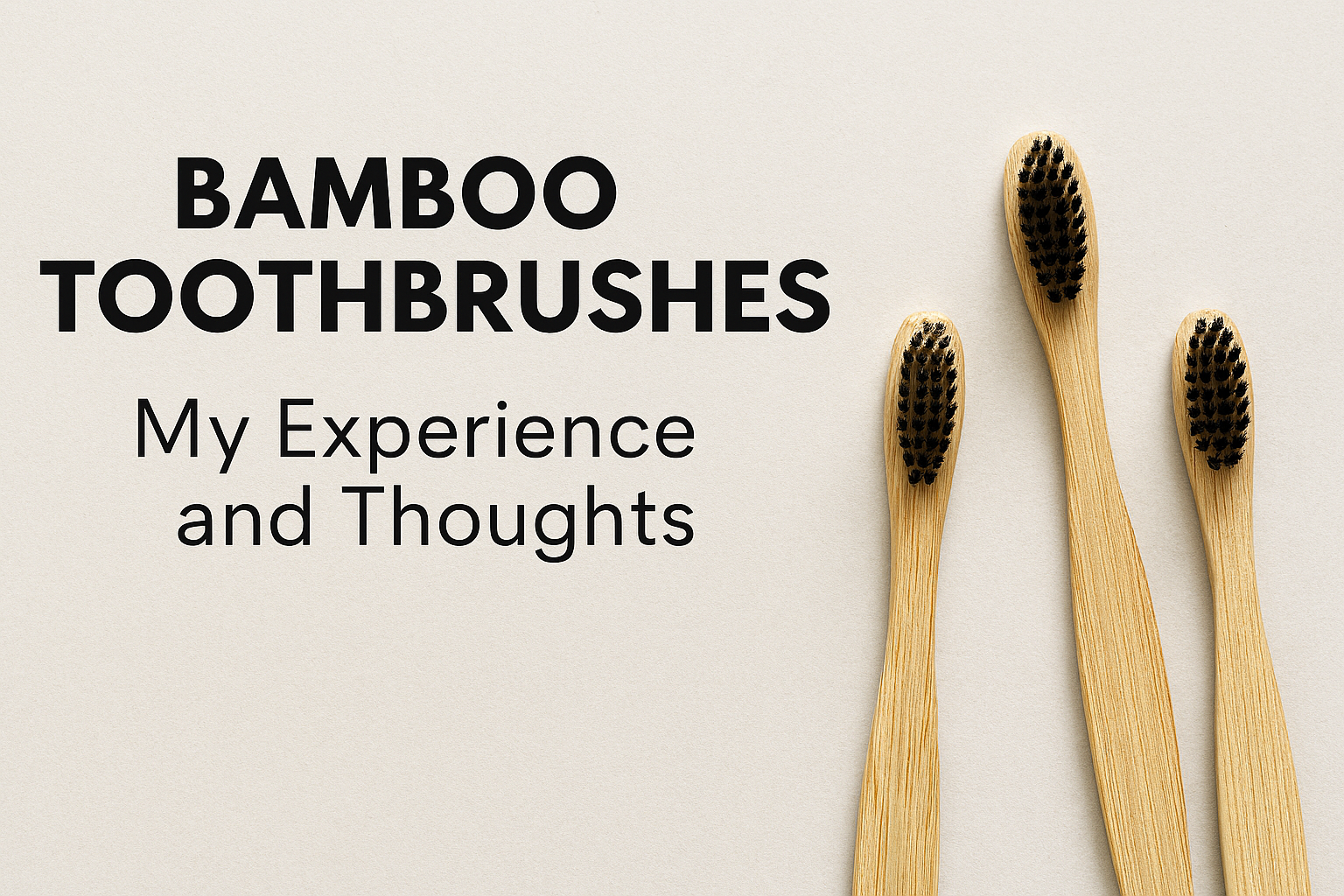
Over the past 6–9 months, I’ve tried a variety of bamboo toothbrushes. Overall, I’ve found that they wear well, do the job just as effectively as conventional plastic toothbrushes, feel nice to hold, and — most importantly for me — can usually be disposed of with a much clearer conscience. Switching to a bamboo toothbrush is often one of the first swaps people make when trying to reduce plastic waste, and for good reason. However, as I’ve learned, not all bamboo toothbrushes are created equal, and some marketing claims deserve a closer look. Estimated reading time: 5 minutes ✅ Why Bamboo Toothbrushes Are a Popular Zero‑Waste Swap Traditional plastic toothbrushes are almost impossible to recycle and are typically destined for landfill or the ocean. Bamboo toothbrushes, on the other hand, are often promoted as a more sustainable alternative because: Bamboo is a fast‑growing, renewable resource Handles are usually biodegradable or compostable Many brands use plastic‑free or recyclable packaging From a zero‑waste perspective, they’re a clear improvement — but that doesn’t mean they’re perfect. My Experience with Bamboo Toothbrushes Charcoal bristles are often advertised as antibacterial and better at removing plaque. Personally, I did notice that my teeth felt cleaner when using charcoal bristles. However, I later discovered that “BPA‑free charcoal bristles” may still contain synthetic materials, meaning the toothbrush is not fully compostable. ♻️ Are Bamboo Toothbrushes Actually Compostable? All of the bamboo toothbrushes I’ve tried have performed well and felt comparable to standard plastic toothbrushes. I didn’t feel like…

3 Comments

My Pledge to the Planet: 31st December 2018

Well, I think I achieved about an 80% reduction in waste – I did not reach my goal, but this is just the beginning. Taking a zero waste pledge has been an important step in my journey. In fact, the zero waste pledge continues to inspire me to make better choices.

The festive period, of course, was the source of many additional waste – but even so, I still managed to only have half bag of household (non-recycling) waste , and half-full recycling boxes for the last collection of the year – and of course, much of this was from gifts and packaging which I was not in control of. I am quite proud of myself! I honestly think that if I had set this goal earlier, without the festive period, that I would have achieved the 85%! Making this commitment to a pledge for zero waste has made me more mindful in everyday situations.

Estimated reading time: 3 minutes

(more…)

1 Comment

My Pledge to the Planet: Progress

On the 1st October 2018, I pledged to reduce all household waste - esp. plastic - by 85% before the end of 2018. Here’s an update on my zero waste pledge progress. After just one month my waste has been reduced by 50% ... even with a lodger. As the last of the plastic bottles of shampoo etc are being used, I am optimistic to reach my goal.  Estimated reading time: 4 minutes 🌍 Why Making a Pledge Matters Making a personal pledge to reduce waste is about more than hitting a single target by a specific date. It’s a mindset shift — choosing to question habits that have been normalised and replacing them with more intentional, planet‑friendly alternatives. For me, this pledge was never about perfection, but about awareness, experimentation, and long‑term change. Moreover, tracking your zero waste pledge progress can make these shifts more rewarding. When we actively track our waste and reduce our reliance on disposables, even small actions begin to add up. What starts as a challenge quickly becomes a lifestyle adjustment, influencing everything from shopping habits to how we value what we already own. ♻️ Progress Over Perfection One of the biggest lessons from this journey so far has been learning to let go of the idea that zero waste means producing no waste at all. In reality, progress happens in stages. Some swaps are easy and immediate, while others take time, research, or simply waiting until existing products are used up. Tracking zero waste…

0 Comments

Smart Meter

Smart meter benefits include helping you make better sense of the energy you use. As a result, you are in a stronger position to both lower your bills and reduce your environmental impact. EDF finally fitted one for me today – after a very long wait! An engineer came out last year but was unable to install it due to the layout of my mains electricity box. This meant I had to first get an electrician in to rearrange everything. After that, I had to go back onto the waiting list… but persistence paid off, and it’s now installed. Estimated reading time: 3 minutes One major benefit of smart meters is the convenience. Automatic readings mean no more waiting at home for someone to manually read your gas or electricity meter. Given that my gas meter lives in the far corner of a cupboard packed with baking bowls and equipment, this is a huge relief! Smart meters use two-way communication between your home and the energy supplier. Therefore, regular home visits for readings are no longer required. There’s ongoing debate about whether smart meters actually reduce energy consumption. Some research suggests that savings aren’t guaranteed – and I agree that results depend heavily on the individual. For me, the key value lies in visibility. By occasionally checking the in-home display throughout the day or week, you can quickly spot when usage spikes. This naturally leads you to question what’s switched on. It also makes you wonder what might be running…

0 Comments

My Pledge to the Planet: Progress

I am trying my utmost to reduce my waste by 85% before the end of the year. This post is an update on my zero waste pledge progress. It is not that I never recycled (I always have done!), or that I was particularly wasteful, but that there is more that I can do.

What is in place

  • Avoidance of ANY purchases with plastic packaging (yes, this causes funny looks in Tesco when I have veg loose in a bag for life, but what is the point in putting them in plastic for a 5 min journey, when I already have a canvas carrying implement?!)
  • Up-cycling of anything possible: for a friends kids to make stuff with (the cardboard rolls in the middle of wrapping paper are, e.g. excellent swords!)
  • Re-use of boxes and envelopes.
  • Slow integration of alternative products with waste reduction and environmental friendliness as core motivations for choice.

Estimated reading time: 3 minutes

(more…)

0 Comments